

How to Write Lyrics (That Don't Suck) — A Step-by-Step Workflow
TL;DR
Great lyrics come from specificity, not clichés. Follow this 5-step workflow: Theme → Hook → Chorus → Verses → Bridge. Use constraints in your prompts to avoid generic output. Edit ruthlessly for rhyme, meter, and fresh imagery. Try our Lyrics Generator to kickstart your next song →
What Makes Lyrics Work (And Why Most AI Lyrics Feel Generic)
The difference between forgettable lyrics and ones that stick comes down to one word: specificity.
Generic lyrics pile up abstract emotions — "my heart is breaking," "tears falling like rain," "you complete me." These phrases feel familiar because you've heard them in a thousand songs. They slide off the brain without leaving a mark.
Great lyrics, on the other hand, anchor feelings to concrete images. Consider the difference:
| Generic | Specific |
|---|---|
| "I miss you every day" | "Your coffee mug still sits on the counter" |
| "My heart is on fire" | "I burned the toast three times this morning, thinking of you" |
| "We danced all night" | "Your heel marks on the hardwood floor" |
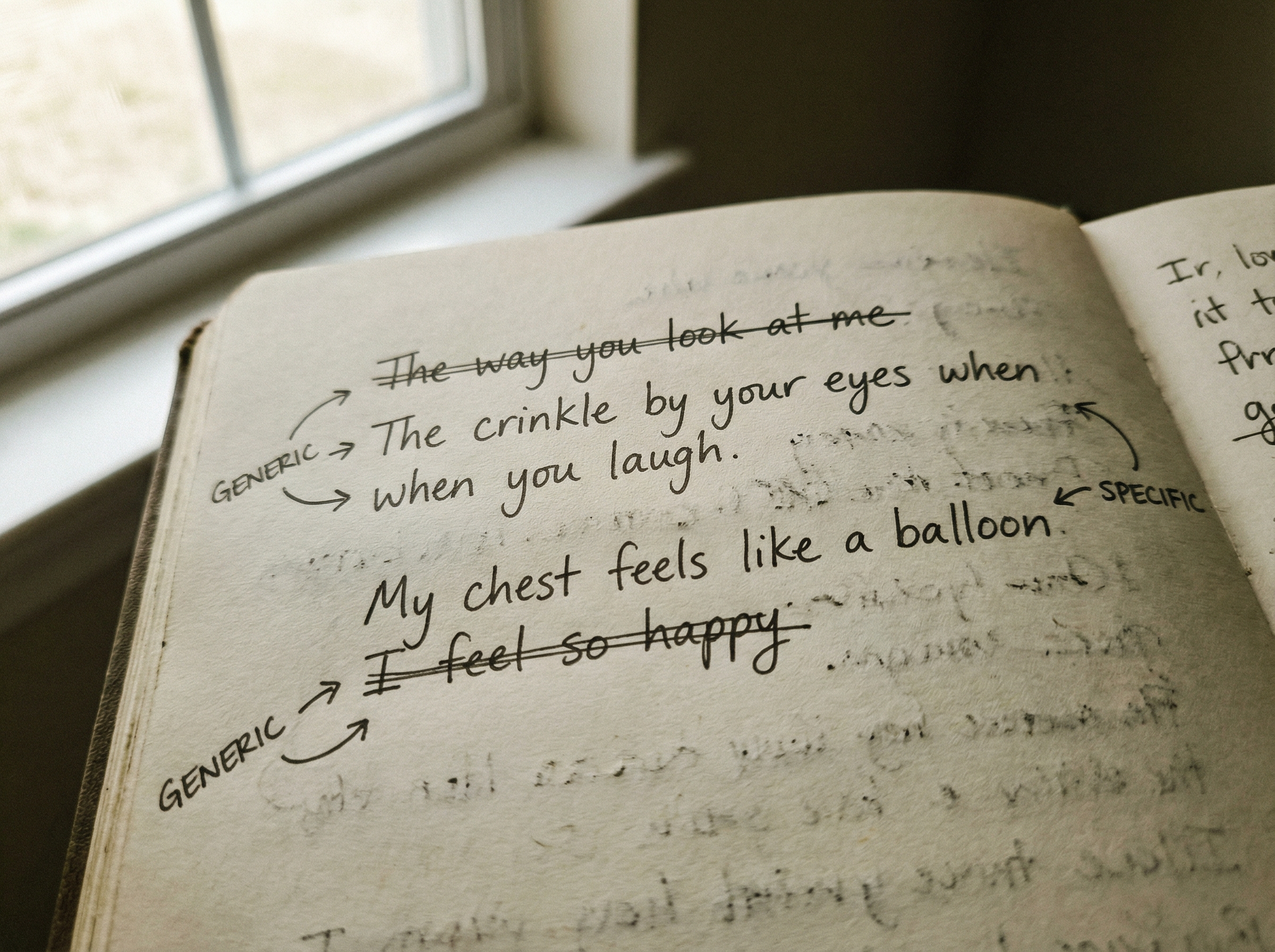
This is exactly why most AI-generated lyrics feel hollow. When you prompt "write a love song," the model defaults to statistical averages — the most common phrases from its training data. The result reads like a checklist of songwriting clichés.
The fix: Give constraints. Instead of "write a sad breakup song," try "write about finding her hair tie behind the couch after she moved out." The constraint forces specificity. The more narrow your starting point, the more unique your output becomes.
Common Song Structures You Can Reuse
Before writing a single word, decide on your structure. Most hit songs follow one of these patterns:
| Structure | Pattern | Best For |
|---|---|---|
| Verse-Chorus | ABABAB | Pop, rock, radio-friendly hits |
| ABABCB | V-C-V-C-Bridge-C | Ballads, emotional builds, power anthems |
| AABA | V-V-Bridge-V | Jazz standards, storytelling, folk |
| Through-composed | No repeats | Narrative songs, theatrical pieces |
Start simple. The Verse-Chorus (ABABAB) structure works for 80% of pop songs. Your chorus delivers the hook and the emotional payoff; your verses set up the story and context. The bridge (if you include one) provides contrast — a new melody, a shift in perspective, or a moment of revelation.
Don't reinvent the wheel. Pick a structure that fits your emotional arc and fill in the blanks. You can always experiment with structure later, but having a framework makes the writing process much faster.
A 15-Minute Lyric Writing Workflow

Here's a practical workflow to get from blank page to rough draft in under 15 minutes. Speed matters here — perfectionism kills creativity.
Step 1: Theme (2 minutes)
Write one sentence that captures the core emotion of your song. Be specific about the feeling and the situation.
Examples:
- "The relief of finally walking away from a toxic relationship"
- "Missing a dead parent while doing something mundane like grocery shopping"
- "The anxiety of waiting for a text that never comes"
This sentence is your compass. Every line you write should point back to it. If a lyric doesn't serve this core emotion, cut it.
Step 2: Hook Line (3 minutes)
Your hook is the single line people will remember. It's the title, the chorus highlight, the phrase that loops in your head for days.
Brainstorm 5 options quickly. Don't filter — just write. Then pick the one with the strongest visual or emotional punch.
Example hooks for "leaving a toxic relationship":
- "I left your keys on the kitchen table"
- "This time I'm not coming back"
- "You can keep the apartment, I'll keep my name"
- "I changed the locks on my own heart"
- "The door didn't slam — I closed it softly"
Hook #5 wins — it's unexpected, creates a visual, and subverts the cliché of dramatic exits.
Step 3: Chorus (5 minutes)
Build 4-8 lines around your hook. The chorus should be singable and memorable, with clear rhyme patterns (ABAB or AABB work well for beginners).
Draft example:
The door didn't slam — I closed it softly (A)
No screaming, no tears, just footsteps in the hall (B)
You thought I'd break, but I walked out calmly (A)
And that silence said more than any fight at all (B)
Notice how the rhymes feel natural, not forced. "Softly/calmly" and "hall/all" work because they don't distort the meaning.
Step 4: Verses (4 minutes)
Verse 1 sets the scene: who, where, when. Give the listener context. Verse 2 deepens the story or shows change over time.
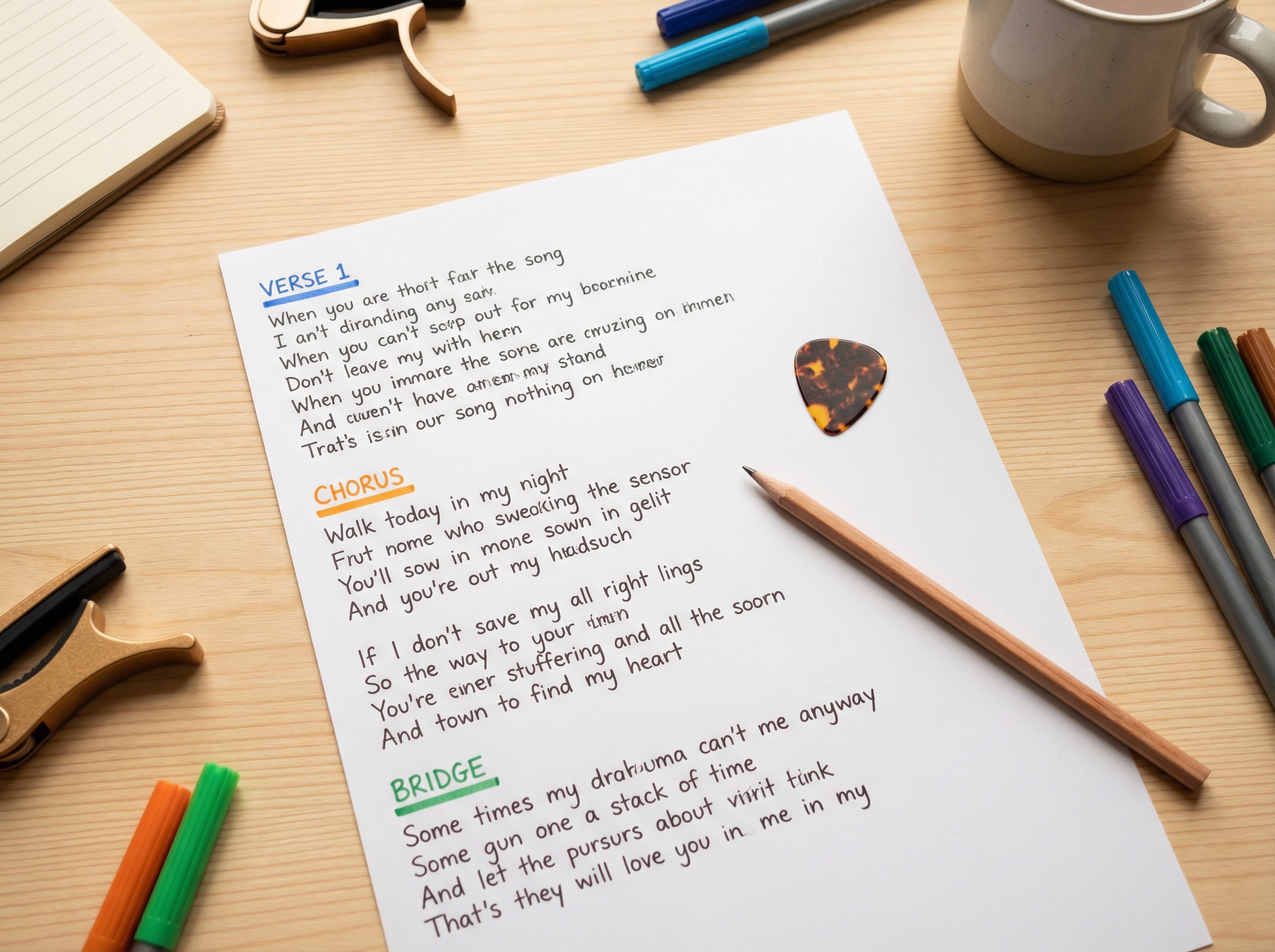
Verse 1 draft:
Three years of your voice in every room
Pictures on the wall I couldn't take down
You made the silence feel like doom
But tonight I'm putting on my coat and walking out of town
Step 5: Bridge (1 minute)
The bridge offers a twist — a new angle, a revelation, a moment of honesty that the verses couldn't reach. Keep it short: 2-4 lines maximum.
Bridge draft:
Maybe you'll miss me, maybe you won't
But I've already started breathing again
Prompts That Actually Produce Usable Lines
If you're using AI to help write lyrics, the quality of your output depends entirely on your prompts. Vague inputs produce vague outputs.
| Instead of... | Try... |
|---|---|
| "Write a love song" | "Write about the smell of her shampoo lingering on your pillow" |
| "Make it emotional" | "Use only concrete nouns — no abstract feelings like 'love' or 'pain'" |
| "Add imagery" | "Describe what the streetlight looks like at 3 AM when you can't sleep" |
| "Write a party song" | "Write about the quiet moment hiding in the bathroom when the bass is still thumping" |
Pro tip: Give the AI a role and constraints. "You are a songwriter who only writes lines under 8 syllables and never uses the word 'heart'" forces tighter, punchier, more original lyrics.
Generate lyrics with constraints using our Lyrics Generator →
Editing Checklist
Writing is rewriting. The first draft is just raw material. Before you call your lyrics finished, run through this checklist:
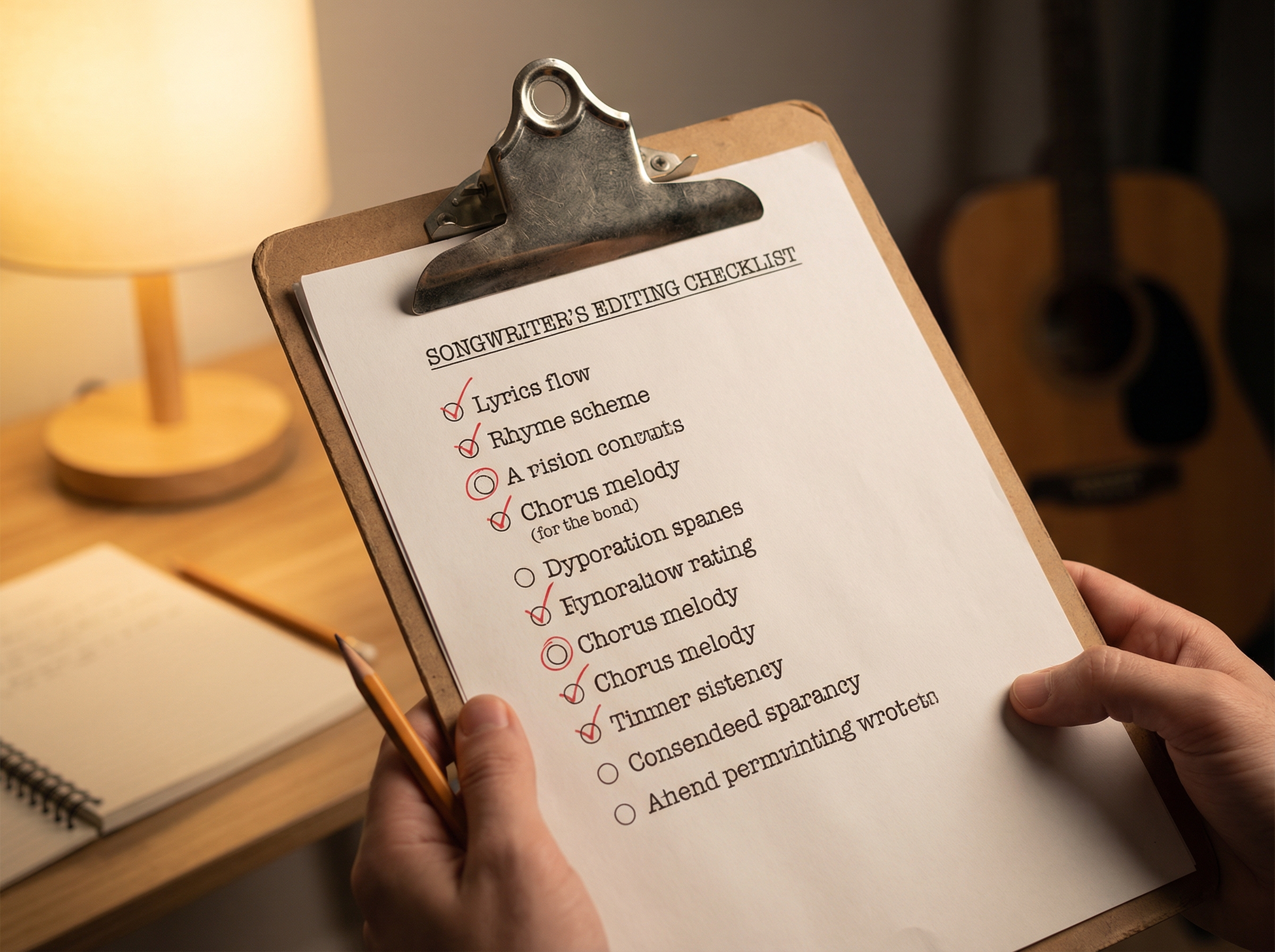
- Rhyme: Does every rhyme feel earned? If a rhyme sounds forced or you had to twist a sentence to make it work, cut it or find a better option.
- Meter: Read it aloud at full volume. Does it flow naturally, or do you stumble over words? Your mouth will tell you what works.
- Imagery: Count your concrete images. You need at least 3 specific visuals that listeners can picture in their minds.
- Repetition: Is your hook repeated enough to stick? Usually 3+ times in a song. The chorus exists for a reason.
- Cliché check: Would you hear this exact phrase in 10 other songs? If yes, replace it with something fresher.
- Singability: Can you actually sing these words comfortably? Avoid consonant clusters and tongue-twisters.
Start Writing Now
You now have a structure, a workflow, and a checklist. The only thing left is to write.
Set a timer for 15 minutes. Pick an emotion. Find your hook. Write without stopping. The first draft won't be perfect — and that's the point. You can't edit a blank page, but you can always revise a rough one.
The best songwriters aren't the ones with the most talent. They're the ones who write the most songs. Volume builds skill. Start today.
Try our Lyrics Generator to get your first draft in seconds →
Table of Contents
Author

Categories
Tags
More Posts

How to Create Songs Online: Step-by-Step Guide for Beginners (2026)
Learn how to create songs online step by step. This beginner guide covers lyrics, music styles, AI vocals, and free tools to make your first song today.
Best AI Music Generator 2026: Honest Comparison (Free & Paid)
We tested 6 AI music generators head-to-head. Compare MemoTune, Suno, Gemini Lyria 3, Beatoven.ai, Mureka and AI Song Maker — see real results and pricing.

Top 5 AI Lo-Fi Music Generators in 2026 (Free & Paid)
Compare the best AI lo-fi music generators. We tested MemoTune, LofiGenerator, Soundraw, Beatoven.ai & Mubert to find the best lo-fi beat maker for you.
Newsletter
Join the community
Subscribe to our newsletter for the latest news and updates