

Best AI Song Maker Online in 2026: 5 Tools Compared
Table of Contents
The best AI song maker in 2026 depends on what you want to finish. MemoTune is the most balanced choice for controlled songs from prompts or lyrics. Suno is strongest for fast full-song drafts and an expanding production workflow, Udio favors exploration, while Mubert and SOUNDRAW specialize in instrumental creator music.
An AI song maker is an online tool that turns prompts or lyrics into structured music with vocals, instrumentals, or both. MemoTune, Suno, and Udio are full-song generators; Mubert is an adaptive background-music platform, while SOUNDRAW is an instrumental generation and editing platform. That distinction matters because these tools do not produce the same type of result.
The important change in 2026 is not simply better audio quality. AI song makers are becoming more controllable: models follow genre and song structure more consistently, editors let creators repair sections instead of starting over, and stems make it easier to continue in a DAW.
MemoTune is our product. This is an editorial workflow comparison, not independent lab testing. We explain the criteria, strengths, limitations, and relevant 2026 changes so you can judge the ranking for yourself.
TL;DR
- Best balanced online song maker: MemoTune AI Song Maker
- Best for fast full-song drafts: Suno
- Best for exploring and refining ideas: Udio
- Best for continuous background music: Mubert
- Best for customizable instrumental tracks: SOUNDRAW
Test two tools with the same prompt. Compare the chorus, pronunciation, genre accuracy, transitions, and export—not just the first 20 seconds.
What Changed in AI Song Makers in 2026?
In earlier generations of AI music tools, the usual workflow was prompt, generate, listen, and reroll. That remains useful for ideation, but it wastes time when only one lyric, transition, or instrument is wrong.
The better 2026 tools are moving in four directions:
- More stable model output: a detailed prompt is more likely to hold its musical direction across the whole track.
- Stronger genre expression: rhythm, instrumentation, vocal delivery, and arrangement respond more clearly to genres and subgenres.
- More local control: section editing, lyric revision, remixing, extensions, and stems reduce the need to regenerate a complete song.
- More production-aware exports: MP3, WAV, stems, APIs, and clearer usage terms now matter as much as the first generated preview.
This changes how the tools should be ranked. A spectacular first result is valuable, but repeatability and correction matter more when you are creating for a campaign, client, release schedule, or recognizable musical style.
How We Compared the Tools
For this comparison, a full-song generator should turn text or lyrics into usable audio without requiring a DAW. Adjacent instrumental platforms are evaluated by the output they are designed to deliver. We compared five practical factors:
- Vocal songs, instrumentals, or both
- Support for your own lyrics
- Style and structure control
- Useful audio exports
- Commercial-use conditions
We also reviewed official product pages, help centers, and release notes current in July 2026. Features and plans change quickly, so confirm current terms before paying or releasing music.

Top 5 AI Song Makers Online
| Tool | Product type | Lyrics and vocals | Main controls | Export | Best for |
|---|---|---|---|---|---|
| MemoTune | Full-song generator | Prompt or lyrics; vocal and instrumental | Genre, mood, tempo, voice, structure | MP3/WAV | Controlled complete songs |
| Suno | Song generator and studio | Prompt or lyrics; vocal and instrumental | Prompt, lyric editor, voices, stems | Audio/stems | Fast drafts and production |
| Udio | Generative music workspace | Prompt or audio; vocal and instrumental | Styles, remixing, Sessions, Voices | Audio | Creative exploration |
| Mubert | Adaptive music platform and API | Prompt or image; instrumental-first | Genre, mood, activity, BPM, API | Audio/stream | Background music and apps |
| SOUNDRAW | Instrumental generator | Instrumental-first | Energy, instruments, length, arrangement | Audio/stems | Video and creator music |
2026 Product Status at a Glance
| Tool | 2026 status | Why it matters |
|---|---|---|
| MemoTune | More stable model control and stronger genre expression | Produces more repeatable results across musical styles |
| Suno | v5.5, Voices, Custom Models, lyric editing, and advanced stems | Extends the workflow beyond one-shot generation |
| Udio | Sessions, Styles, Voices, and remixing define the current workspace | Supports iterative creative exploration |
| Mubert | Mature adaptive-music and API capabilities | Fits apps, streams, and continuous background audio |
| SOUNDRAW | New genres, developer tools, mastering, and platform expansion | Covers more creator and business workflows |
1. MemoTune — Best Balanced AI Song Maker Online

MemoTune AI Song Maker is a full-song AI generator supporting both text-to-song and lyrics-to-song workflows. You can choose genre, mood, tempo, voice direction, and vocal or instrumental output, then export MP3 or WAV. Structure tags such as [verse], [chorus], and [bridge] help shape your own lyrics into a complete arrangement.
The workflow is direct: describe the result, adjust explicit settings, generate, then revise one variable at a time. It fits song demos, video hooks, podcast themes, gift songs, and short branded tracks.
What Changed for MemoTune in 2026?
MemoTune moved to a more stable music generation model and improved how its controls are translated into the final output. The practical benefit is greater consistency: genre, mood, tempo, vocal direction, and song structure are less likely to drift away from the original request halfway through a track.
The model also expresses a wider range of musical styles more clearly. A pop prompt should not merely receive a different label from a rock, cinematic, electronic, or hip-hop prompt; the rhythm, instrumentation, energy, vocal delivery, and arrangement should communicate the genre. For a focused example, the MemoTune AI Rap Generator applies this approach to trap, drill, old-school boom bap, freestyle, and other rap directions while keeping lyrics, beat, and vocal delivery in one workflow.
This added stability does not eliminate iteration. It makes iteration more useful: instead of repeatedly asking for the same idea and hoping for a lucky result, you can change one meaningful variable and compare the difference.
Choose it if: you want lyrics, vocals, instrumentals, and practical exports in one browser workflow.
Skip it if: you only need an endless ambient stream or detailed multitrack editing inside a full DAW.
2. Suno — Best for Fast Full-Song Drafts
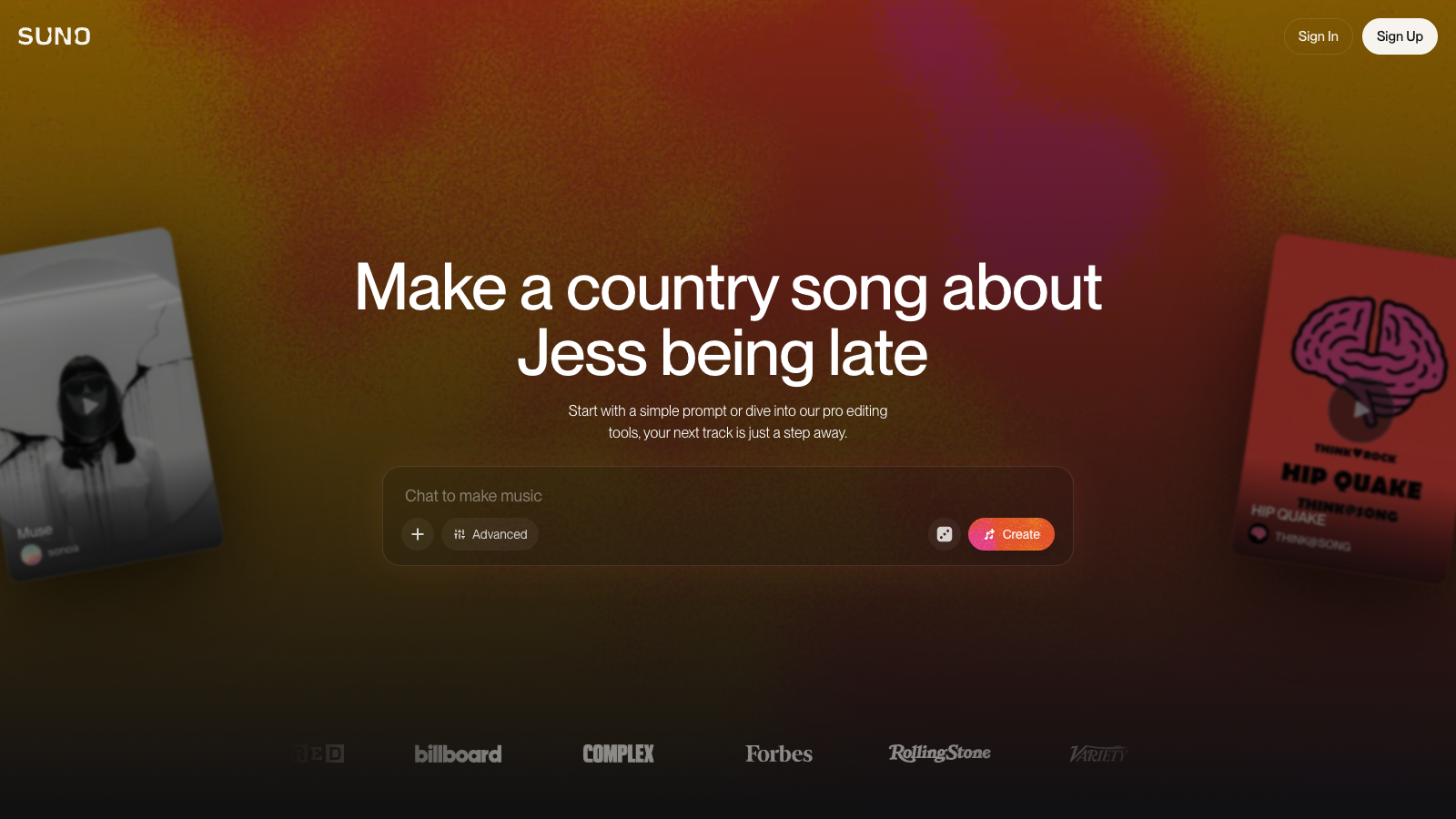
Suno is an AI song generator and browser-based production workspace. It turns a short description into a complete arrangement with lyrics and vocals, making it useful for comparing several song directions quickly. Its strength is immediacy: a short idea can become something that already feels like a song rather than a disconnected loop.
What Changed for Suno in 2026?
Suno expanded beyond fast one-shot generation. Its March 2026 v5.5 release introduced richer arrangements, sharper vocals, personal Voices, Custom Models trained from a creator's catalog, and preference learning through My Taste. Later updates added a fuller lyric-writing environment and more precise stem separation. Suno's official release notes show the direction clearly: generation is becoming one part of a broader writing, editing, personalization, and production system.
This makes Suno more useful after the first draft. You can work on lyrics, separate instruments, and move material toward a multitrack workflow instead of treating every output as a finished black box.
The tradeoff is precision: a draft may miss a lyric, transition, or arrangement detail, so iteration remains part of the workflow.
Choose it if: you value quick, surprising full-song drafts.
Skip it if: your project requires repeatable structure and tightly controlled details.
3. Udio — Best for Creative Exploration

Udio is a generative music workspace for creators who compare variations, remix ideas, and discover direction through iteration. It generates vocal and instrumental music, but exploration is its real strength. Prompts, Styles, audio uploads, extensions, inpainting, and remixes offer several ways to approach the same musical idea.
Udio's Product Position in 2026
Udio enters 2026 as a more coherent creative workspace. Its current workflow emphasizes fine-tuning on the Create page, while Sessions provides a waveform-centered environment for extending and editing material. Styles and Voices add reusable creative direction. Udio's official changelog documents the major features that define the current experience.
The result is less dependence on finding a perfect prompt. Udio is increasingly useful when you want to start with an idea, compare branches, and discover the track through successive decisions.
It works like a musical sketchbook, but is less direct when the deliverable is already fixed.
Choose it if: discovery and experimentation are part of the goal.
Skip it if: you need a predictable prompt-to-export path under deadline.
4. Mubert — Best for Background Music and Loops

Mubert is an adaptive music platform and API that solves a different problem from lyric-led song generators. It focuses on continuous, mood-matched instrumental music for videos, podcasts, streams, apps, and environments where the music should support rather than dominate.
Mubert's Product Position in 2026
Mubert's 2026 advantage is the maturity of its product and API use cases rather than a pivot toward vocal pop songs. Its current AI Music API supports text- and image-to-music, genre, mood, activity and BPM controls, long-form generation, real-time streaming, and adaptive intensity across more than 150 genres and moods.
That makes it more relevant to developers and content systems. A game, fitness app, livestream, retail environment, or UGC platform may need music that lasts, adapts, and can be generated inside the product. That requirement is very different from making a three-minute song with a memorable chorus.
Choose it if: you need instrumental beds, loops, or long-running background audio.
Skip it if: you want your own lyrics turned into a structured vocal song.
5. SOUNDRAW — Best for Instrumental Arrangement Control

SOUNDRAW is an AI instrumental generator with controls for energy and arrangement. It suits YouTube videos, ads, podcasts, and other projects where timing and editability matter more than vocals. You can shape mood, length, instruments, energy, and song flow before downloading a finished track or stems.
What Changed for SOUNDRAW in 2026?
SOUNDRAW continued to expand its production and distribution footprint. Its official release log lists new Jazz, Boom Bap, and West Coast styles, an indie developer API, apps for iOS and macOS, music for commercial spaces, and a mastering integration with TuneCore Japan.
The pattern is significant: SOUNDRAW is not trying to win the lyric-to-vocal-song category. It is becoming a larger instrumental creation system for artists, content creators, businesses, and products that need editable, licensable music.
Choose it if: you want to shape an instrumental around a video or content timeline.
Skip it if: the vocal performance or lyric narrative is the center of the project.
Which AI Song Maker Should You Choose?
| Your goal | Best starting point |
|---|---|
| Turn your own lyrics into a complete song | MemoTune |
| Generate several vocal-song concepts quickly | Suno |
| Explore unusual musical directions | Udio |
| Add unobtrusive music under narration | Mubert |
| Customize an instrumental around a video edit | SOUNDRAW |
Use one reproducible test prompt across your shortlist: “uplifting indie-pop birthday song, warm vocal, 95 BPM, simple chorus, nostalgic but not sad.” Then listen for lyric accuracy, chorus consistency, transitions, and whether the download fits your editing workflow.
For genre-specific testing, use a prompt that contains production details rather than only a genre name. For example: “modern drill rap, dark minor-key piano, sliding 808 bass, restrained hi-hats, tense male vocal, short hook, 142 BPM.” This reveals whether a tool truly expresses the requested style or merely produces a generic track with different metadata.
Licensing: Check the Output, Not Just the Marketing
“Royalty-free,” “commercial use,” and “ownership” do not always mean the same thing. Rights may depend on the plan used when a song was generated, and copyright treatment of primarily AI-generated material remains unsettled. The wider industry is still negotiating these questions, as reflected in AP's reporting on Suno, Udio, and music rights.
Before publishing, check the tool's current terms, whether attribution is required, whether free-plan output can be monetized, and whether distribution to streaming platforms is allowed.
FAQ
What is the best free AI song maker online?
Free access changes frequently. Use a free tier to compare prompt accuracy, vocals, and workflow, but verify download limits and commercial rights before publishing. The best free test is the one that lets you evaluate a complete result—not just a short preview.
Can an AI song maker sing my own lyrics?
Yes. MemoTune, Suno, and Udio support lyric-led vocal generation. For better results, separate lyrics into sections such as [verse], [chorus], and [bridge], and keep each line easy to sing.
Can I use an AI-generated song commercially?
It depends on the platform, plan, generation date, and intended use. Never assume that a free download includes monetization or distribution rights; check the current license before releasing client work, ads, or streaming tracks.
Which AI song maker has the best genre control in 2026?
MemoTune is the strongest starting point when you want explicit genre, mood, tempo, voice, and song-structure controls in one workflow. Suno and Udio can produce a broad range of styles, but their creative process often relies more heavily on prompting, references, generation, and iterative editing. Test your specific subgenre before committing to a plan.
Are AI song makers replacing music production software?
Not completely. They are replacing some blank-page work and accelerating drafts, variations, background tracks, and demos. A DAW remains more precise for recording, comping, detailed automation, mixing, mastering, and collaboration. The most useful 2026 workflow is often AI generation followed by selective editing or DAW finishing.
Final Verdict
Choose by output, not brand recognition. Suno and Udio favor generation plus exploration; Mubert and SOUNDRAW fit instrumental background and production use cases. For a controlled vocal or instrumental track from a prompt or your lyrics, MemoTune is the most balanced starting point—especially when genre expression and repeatable controls matter.
Try MemoTune AI Song Maker and run the same prompt you use in another tool. The better choice is the one that needs fewer compromises before you can publish.
Table of Contents
Author

Categories
Tags
More Posts

Top 5 AI Lo-Fi Music Generators in 2026 (Free & Paid)
Compare the best AI lo-fi music generators. We tested MemoTune, LofiGenerator, Soundraw, Beatoven.ai & Mubert to find the best lo-fi beat maker for you.

Top 5 Suno Alternatives in 2026 (Actually Worth Trying)
Looking for Suno alternatives? We tested the 5 best AI song generators that rival Suno — MemoTune, Udio, Mureka, AIVA & Beatoven.ai compared.
Best AI Song Generator 2026: Honest Comparison (Free & Paid)
We tested 6 AI song generators head-to-head. Compare MemoTune, Suno, Gemini Lyria 3, Beatoven.ai, Mureka and AI Song Maker — see real results and pricing.